A Collective Experience

Updated: Aug 17
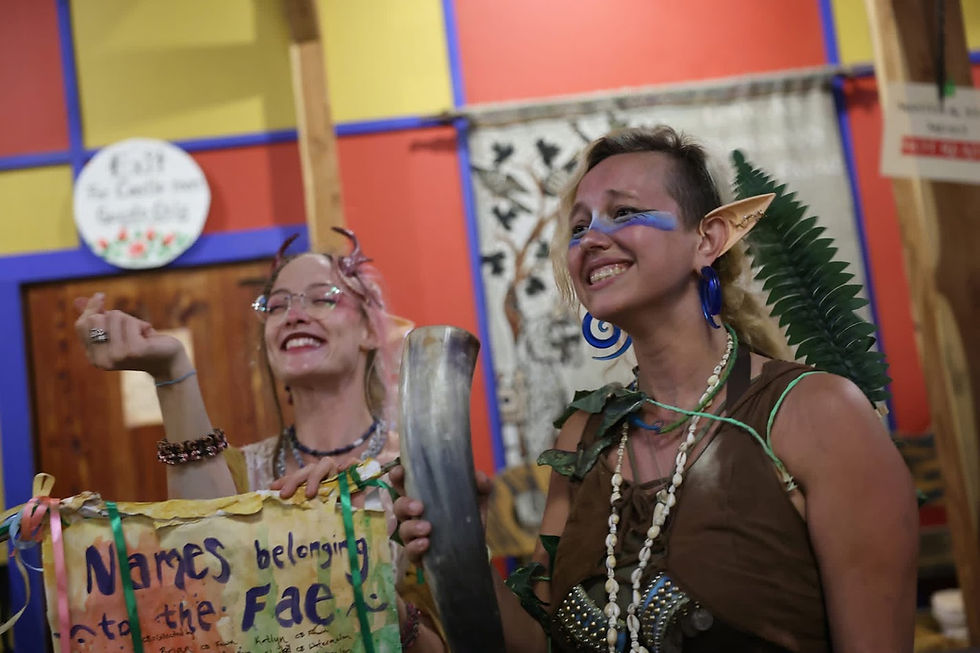
The Future Looks a Lot Like a Renaissance Faire

There is something wonderfully ironic about building a company inspired by faeries, traveling performers, storytellers, puppeteers, artisans, jesters and Renaissance festivals while living through one of the most technologically accelerated periods in human history.
The more futuristic the world becomes, the more convinced I am that we are going to need some very old things.
Stories told face-to-face.
Artists making things with their hands.
Music you can feel through the floor.
A performer looking directly at you and changing the story because of something you said.
Children running around pretending they are wizards.
Adults doing essentially the same thing, except we've learned to call it LARP.
And communities of creative people who understand that sometimes the most valuable thing you can give another human being is an experience.
That idea is at the heart of HoneyBubbles.
Why We Call Ourselves a Guild
When I began imagining what HoneyBubbles could become, I knew fairly quickly that I didn't want to build a traditional entertainment company where one person owns the brand, hires a collection of interchangeable performers, and keeps the largest share simply because their name is on the paperwork.
That doesn't make sense to me.
If a fire spinner spends years learning their craft, a puppeteer brings a creature to life, a face painter transforms a child into a dragon, or a storyteller holds twenty kids completely spellbound for an hour, that artist is creating the value.
I want our business model to reflect that.
HoneyBubbles operates as a growing collective of independent artists and performers. I handle the less glamorous magic behind the curtain—branding, coordination, booking, advertising, supplies, client communication and bringing talented people together—but whenever possible, the majority of what we earn from an experience should go back to the performer who actually made that experience happen.
Our performers also receive their tips.
That is intentional.
I believe artists deserve to be paid like their work matters, because it does.
The goal isn't merely to create more gigs. It's to create an ecosystem where unusual creative skills can actually become valuable work.
The person who spent ten years learning circus arts.
The theatre kid who never stopped doing voices.
The fantasy artist.
The puppeteer.
The professional clown.
The person who somehow owns an extremely convincing dinosaur.
These are not frivolous talents.
They're part of what makes the world interesting.
Be the Change, but Make It a Business Model
There is a phrase I've heard throughout my life: be the change you want to see in the world.
It's lovely.
It's also considerably harder when taxes and invoices become involved.
But I still believe in it.
I want HoneyBubbles to prove that a company can grow by connecting talented people rather than extracting from them.
That collaboration can be a competitive advantage.
That artists don't have to fight over one tiny slice of opportunity when we can build something larger together.
If one performer receives a request they can't fulfill, perhaps someone else in the guild can. If a client wants something none of us currently offer, perhaps we know an artist who does.
Eventually one performer knows another performer, who knows a costumer, who knows a magician, who knows someone with stilts and an alarming number of juggling clubs.
This is how creative communities have always worked.
HoneyBubbles simply gives that network a name, a structure and a door customers can walk through.
The One Thing Technology Cannot Replicate
We are also building this company during an unusual moment for creative work.
Artificial intelligence can already write, illustrate, compose, edit, organize and automate things that would have sounded like science fiction not very long ago.
I use technology myself. I'm not interested in pretending otherwise.
But it has made me think very carefully about which parts of creativity are actually irreplaceable.
And I keep arriving at the same answer:
The human being.
An algorithm can generate a picture of a wizard.
It cannot walk through the door of your child's birthday party as the wizard.
It cannot notice that one child is hanging back from the group and quietly invite them into the story.
It cannot feel the energy of a room and realize that the kids desperately need to run around before anyone attempts the next craft.
It cannot accidentally get roasted by an eight-year-old and improvise an increasingly dramatic wizard feud about it.
It cannot paint something across someone's face while they excitedly explain the character they invented.
It cannot spin fire ten feet away from an audience who collectively gasps when the flames rise.
And it cannot create that strange, electric moment when performer and audience stop being separate things and everyone becomes part of the same story.
That isn't content.
That's presence.
And presence is going to become more precious, not less.
Why Fantasy Keeps Calling Us Back
Maybe that's part of why fantasy spaces feel so compelling right now.
Renaissance festivals, cosplay, tabletop roleplaying, live-action roleplay, immersive theater and fantasy events all offer something increasingly rare:
They require participation.
You can't experience a Renaissance faire exactly the same way you experience a television show.
You walk through it.
You dress for it.
Someone heckles you from a stage.
A merchant explains how they made something.
You hear music somewhere in the distance and wander toward it.
You meet characters.
You make choices.
You become part of the scenery for everyone else.
The audience helps create the world.
And perhaps that is exactly what people are hungry for.
For all of our incredible technology, human beings are still the same strange social creatures who once gathered around fires telling stories and pretending monsters lived beyond the edge of the woods.
We've just gotten considerably better costumes.
Roleplaying the Past, Building the Future
There's a funny contradiction in all of this that I absolutely adore.
Some of the communities experimenting with what creative work might look like in the future are dressed like they live several hundred years in the past.
Artists selling directly to customers.
Performers traveling between events.
Small creative businesses collaborating instead of functioning like enormous corporations.
People trading specialized skills.
Temporary villages appearing around festivals.
Communities forming around shared stories and experiences.
A modern Renaissance faire can look backward aesthetically while doing something remarkably forward-thinking economically and socially.
Maybe the future doesn't have to mean replacing everything old with something digital.
Maybe some of the future looks like rediscovering what humans were always exceptionally good at.
Gathering. Creating. Performing. Teaching. Playing. Telling stories. Making things with our hands.
HoneyBubbles is my little contribution to that future.
A company built around experiences technology cannot fully reproduce.
A network designed to make creative talent more valuable, not less.
A place where artists can bring whatever strange little specialty they've spent years cultivating and discover that someone, somewhere, would absolutely love to hire them for it.
And a world where children get to watch adults take imagination seriously enough to build their lives around it.
If that's the future we're heading toward, I think we'll fit right in.
We'll just be roleplaying the past while we get there.
— Lindsey Morebees, Founder & Guildmaster, HoneyBubbles Magical Entertainment

Comments